Murky Mirror: Truth and Consequences
A meditation on the state of the world today, in the mirror of the 14th Century

Author’s note: This post focuses on the US and Europe, where I have some direct knowledge of history, politics and business. Other parts of the world experienced different historical and political dynamics, but much of our now more-connected world shares in the current situation.)
As the world around us shifts shape, it’s tempting to look at recent history, the US Constitution and the like for perspective. But instead, I keep thinking farther back, to when our institutions and assumptions were quite different, to the days of A Distant Mirror: The Calamitous 14th Century by Barbara Tuchman, an excellent recounting of the 14th century in France, at the beginning of a period of famine precipitated by bad weather and farm animal diseases, the Black Death epidemic, a schism in the Catholic Church, and purposeless wars, which together resulted in a population that shrank by roughly half. Now again we have more calamities and random events, a black-swan period collectively but each within the realm of overall probability. Yet the great pendulum of time appears not to be swinging back in the usual curve between two points, but off in some third dimension. What has changed since then…and how much, due to human nature, has not?
Back in the 14th century, nobles owned and ruled the land, and de facto owned the serfs who lived on that land. (Kings were in theory superior, but there was no way for them to keep tabs on what was going on in all the local fiefdoms. No spreadsheets to help, let alone surveillance cameras!) The noblemen learned how to fight - jousting in tournaments and launching battles “for real” - but had little sense of strategy; hence, a continuous stream of skirmishes but no lasting victory, resulting in the 100 Years’ War (1337-1453) and continuing turmoil without resolution. The clergy were trained formally, promoting the ideology of Christianity, but in practice they were just agents of another predatory institution, exacting entry fees to Heaven from the nobility. They also managed or mediated other relationships - including transactions such as marriages - among individuals and families.
As for the serfs… their role was to serve rather than exonerate the nobility, producing food and fuel as payment for the land they lived on, with little choice to do otherwise. Those serfs lived in drafty huts, with one another and with random farm animals as well. (Unlike slaves, who “belonged” to other people, serfs belonged to the land. If the land was transferred through marriage, inheritance or some such transaction, the serfs went with it. Now, in some sense, workers belong to companies, or suffer the daily challenges of gig or self-marketing work.)
Yet everyone was helpless against the Black Death and other calamities, which culled roughly half of the population and caused a great reset: Cheap labor became expensive - or at least, less cheap - and improvements in farming equipment made the workers themselves more productive, fostering a shift in the respect they garnered.
Fast forward to today, through the Renaissance (14th to 17th centuries), the Age of Exploration (15th to 17th centuries), the Scientific Revolution (16th to 17th centuries), the Agricultural Revolution (17th to 19th centuries), and finally the Industrial Revolution (18th to 20th centuries). Technologies and equipment including telescopes and reading glasses, the printing press, and ships and bicycles among others, brought new knowledge of the world at hand and far away.
As governments consolidated and democracy of sorts emerged, some of the nobility took over - mostly given their roles by (some of) the people rather than by God. Other nobles, especially the younger sons, shifted to owning factories, merchant ships and ultimately companies of all kinds, creating a whole new sector of private business with a professed ideology of free people and scalable free markets. Factories and machines grew in productivity, reducing the primacy of land and ultimately turning serfs into paid workers. The Industrial Revolution saw huge changes in society that included much more mobility - geographically, economically and even socially. In the Soviet Union and then Russia (and also China, which I know less well), the path diverged for a while, with corrupt Communism that was eventually replaced by equally corrupt capitalism and now a commingling of corrupt government and equally corrupt business enabled by and subservient to the state.
You might call one arc of the Industrial Revolution the “Trading Revolution,” best exemplified by the East India Company - perhaps the SpaceX of its (long) day, from 1600 to 1874. To quote Wikipedia, “At its peak, the company was the largest corporation in the world by various measures and had its own armed forces in the form of the company’s three presidency armies, totalling about 260,000 soldiers - twice the size of the British Army at certain times.“ Along with its competitors, it spread the use of or addiction to new delights from overseas: tobacco, opium, sugar, spices, tea and cotton, among others. Cotton in particular also fostered new industrial scale and exploitation of workers, with the use of slaves for picking it in the US South, and cotton mills, spinning wheels and the like in England. (My grandfather’s aunt and mother worked in the cotton mills of northern England starting from the ages of 4 and 8, respectively. More on my grandfather - who became “Sir George” - some other day.)
Along this same winding timeline and even as both governance and governments (and business) became more centralized, the coherence of the religious sector declined with the rise of Protestantism and many other sects, plus migration (emigration, immigration and invasion) in all directions enabled by boats, trains, and ultimately bicycles and cars, along with better maps. Still, the clergy kept more or less the same role, even though it now holds diminished power in a world where location no longer defines religion, and atheism, fragmented churches and religious sects flourish. Can Pope Leo help regain religion’s (not the church’s) stature?
Second verse, not quite same as the first
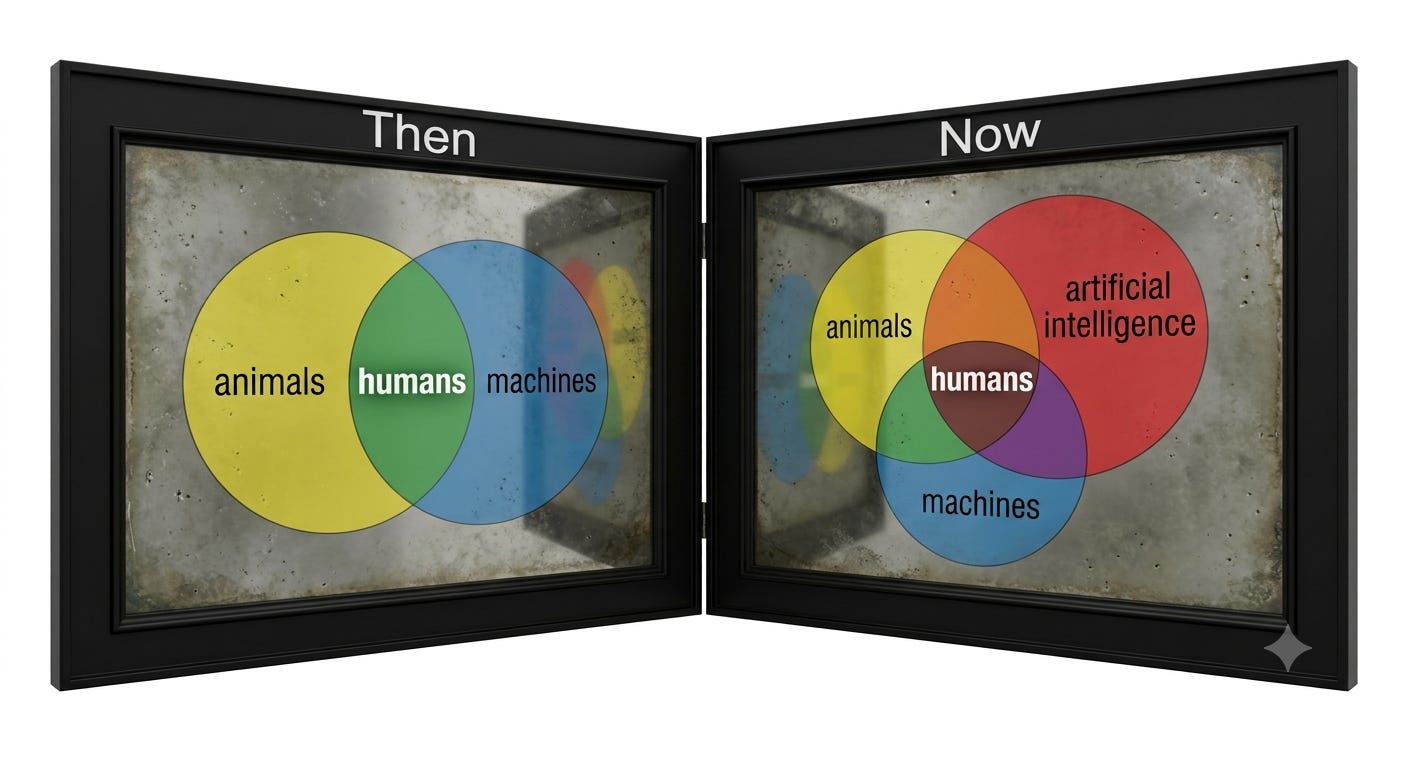
Somehow that crumbling set-up from 700 years ago resonates in the US today, not repeating but rhyming. Like the jousting nobles of old, our leaders perform more than they govern, offering ultra-processed content and personalities, the modern equivalent of bread and circuses. Abroad, instead of aid or investment, we now offer tournaments and wars without strategy. The zeitgeist favors performance and brands over delivery, money over value, identity over policy. Both businesses and politicians used to make promises of what they would do or deliver; people were buying results. Now people are buying or voting for products or leaders that will make them feel part of a tribe. Even as gambling and prediction markets try to turn sports and other aspects of everyday life into transactions and one more quest for money, the current excitement and (mostly) friendliness surrounding the FIFA World Cup show the need for and celebration of human tribes. We are meant to share those connections, superficial as they may sometimes be.
We watch as all around us as business and government intermingle in both directions, with leading noblemen-cum-businessmen taking on what look like government roles - from Elon Musk’s brief stint at DOGE, to a string of Wall Street executives “donated” by either party to the SEC and other regulatory agencies, to various others representing their own and perhaps Trump’s business interests in negotiations with other countries - neglecting the voters they supposedly serve. We are back to a world where people genuflect to nobles, not at altars.
Meanwhile, the US Supreme Court’s Citizens United ruling (2010) opened the way for those with money to spend it on helping politicians to win or keep office - and as of last month, the current Supreme Court gave them new license to spend it more directly on candidates (June 30). Politicians (especially those aspiring to or new in the job) spend more time raising money for their own campaigns/political survival than they do figuring out how to spend the public purse, ideally for the benefit of all.
Elsewhere, religion too often means identity and tribe more than belief. Preachers are valued for being “authentic” rather than for following the dictates of their church - let alone those of an actual religion. The clergy have lost some of their influence to the intellectual elites of the universities and to Substack writers, along with the proliferating think tanks that espouse conflicting views of the world and the proper role of all the other institutions. Those elites are selling access not to heaven as much as to Davos or the annual Allen & Co. Sun Valley Conference. (I won’t say where I was, but two weeks ago I overheard two men chatting; one mentioned he was heading to Sun Valley, while the second had other plans - unspecified. Did he have an even better offer…or did he hesitate to say that he had no offer at all?) Meeting the right funder or politician at one of these events can result in heaven on Earth.
For some people, money gets you political power. But for many rich people, money is often most important as a form of rank rather than of actual physical wealth or comfort, which is taken for granted. By contrast, for those who actually work for their money - for wages or a salary rather than a cut of various transactions - money is real and guides their everyday decisions and trade-offs, even as they are lured to spend it on ultra-processed temptations (Flamin’ Hot Cheetos or even fake shrimp for religious pseudo-observance, as well as AI- and marketing-infused content) of little human value.
How does AI change our (perception of) human nature?
But now, this fluid situation - reflecting long-term trends, the (re-)election of a single man (which may reflect some of those trends), the social separations and mistrust due to COVID, and the rise of social media - is likely to be upended yet again by the advent of AI and AI agents at scale. Human nature persists, but the rise of AI is changing our perception of our intelligence - which we may value too much - against our humanity and wisdom.
Just as new farming equipment and the replacement of oxen with horses made 14th-century serfs more productive and valuable, AI may do something similar: It replaces human intelligence in many aspects, but it also provides great capacity for those who learn how to use it. At the same time, AI cannot replace human love or kindness, or humans’ need for one another…and we need to recognize that more broadly. This seems to be happening: The widespread rejection of AI and data centers may carry more weight - and hold more truth - than the reactions of the (19th-century) Luddites.
This is our existential question: Not what will AI do to us, but how will we react to it? Will we understand how to value human existence and human attention in a world of seductive “artificial” offerings of all kinds? Can we understand the value of the artisanal? And can we feel that we play an important part in this future? What’s the clarion call that will wake us all up and shake us out of our artificial dreams?
As our current Pope Leo (2025- ) has observed, AI will disrupt and shape his papacy much as the Industrial Revolution did for that of Pope Leo XIV (1878-1903). Is AI a new kind of private land - to be owned and exploited by the new nobility? Or can it be a new open prairie, to be farmed by anyone willing to set up a homestead on an infinite plain? Will AI actually become a new sector, crossing and disempowering nation-states and business as some new and intangible yet powerful part of the world’s (or solar system’s) structure? Nation-states were defined by geography (along with their nobility). Businesses are defined by their ownership, which now crosses multiple geographies and jurisdictions. The new sector of AI agents may be even more elusive - and harder to hold accountable. As for us, are we defined by our online personas (enhanced with all kinds of AI tools) or by those we love and who love us - not because we were matched by an algorithm, but because we grew to love one another through continued sharing?
In one way or another, I’ve been pondering this for a long time. My favorite story about the need for clear vision in a world of murkiness comes from the time I was lucky enough to sit next to late Associate Justice of the Supreme Court Sandra Day O’Connor. I asked her about the difference between the way people vote and the way they sit on a jury. She was appropriately discreet and did not name any cases, but she said that while not all juries decided correctly (in her opinion), she had seen only two cases where the jury had not performed their duties with diligence and thoughtfulness. Voters tend to think they ought to vote but it’s more of a gesture than an action, whereas sitting on a “jury of your peers” sends the message that you are in charge of an outcome, one that may change several people’s lives. There is no intermediary, no crowd to join, little distance between you and the person whose future life (or death) hangs in the balance. The jurors take their job seriously and work to uncover the facts and understand the underlying law. In a world of performativeness vs. actual performance, we must treasure and realize our ability to fully understand truth and its consequences.
Hi @Matthew Amsden - sorry for the slow reply... It would take a book to answer that, and I am just finishing the final edits! But in short, right now, understand that everything involves trade-offs. And there is no perfect trade-off, because you always have to sacrifice some things in your short finite life. THEREFORE, figure out the value - not the price - of your trade-offs yourself; do not rely on the judgments of others. Rely on the love of those you love back.
More soon!
Love,
Esther
Thank you for YOUR human attention, @Iman!!